 KastorFlow
Updated November 6, 2026
KastorFlow vs Kortex
Two Chrome extensions for NotebookLM, now Gemini Notebook. We make KastorFlow; Kortex's features are from its own site.
Kortex and KastorFlow overlap more than most NotebookLM extensions. Both save AI chats, import links in bulk, run automations, publish Audio Overviews to a podcast feed and work with AI agents through MCP. The difference is what happens after the sources are in. KastorFlow audits a notebook and fills the gaps you approve, builds a research notebook from a topic, merges a YouTube playlist into one source and captures a video's slides with its transcript. Both run in the same Gemini Notebook account, so you can try one next to the other.
Feature by feature
| Feature | KastorFlow | Kortex |
|---|---|---|
| Audit a notebook: score every source, flag weak ones, show missing kinds | Yes | — |
| Fill the gaps with sources you approve | Yes | — |
| Build a research notebook from a topic | Yes | — |
| Build, audit and fill gaps on a schedule | Yes | Schedules questions, Audio Overviews and saved workflows |
| Automations | 10 triggers, 16 actions | 8 triggers, 11 actions |
| Save chats from ChatGPT, Claude, Gemini, Perplexity and more | Yes | Yes |
| Several links, a CSV of links, open tabs or an RSS feed | Yes | Yes |
| Merge a YouTube playlist or channel into one source | Yes | — |
| YouTube playlists, channels and search results, a source per video | Yes | — |
| A video's frames and transcript as one PDF source | Yes | — |
| Library map of every notebook, knowledge graph of each | Yes | — |
| Find duplicates in a notebook; delete sources in bulk | Yes | Removes duplicates when merging; deletes failed sources in bulk |
| Check the notebook has room before importing | Yes | — |
| Audio Overviews in your own podcast feed | Yes | Yes |
| MCP for AI agents | Yes | Yes |
| Obsidian, both ways | Yes | Markdown export for it |
| Readwise, Slack, Discord | Yes | — |
| Flashcards straight into an Anki deck | Yes | — |
Kortex's features as listed on kortex-notebooklm.com and its features page, read November 6, 2026. — means they don't mention it, not that it can't be done. The KastorFlow column is checked against the extension itself. Spotted something out of date? Tell us and we'll fix it.
What Gemini Notebook now does without either
Before you compare extensions, check what Gemini Notebook does on its own. Two features we tested on November 6, 2026 cover part of what organizing extensions were for.
Auto-label sources by topic is a button above the source list. In a fresh test notebook, one click sorted our 8 sources into labelled groups, such as Neural Networks and Datasets, in about 8 seconds. You can rename or remove a label, and removing one keeps its sources.
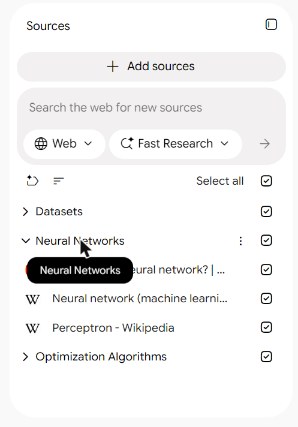
Collections on the home page group notebooks, like folders: name one, then tick the notebooks to add. So for simple grouping you may not need an extension. What Gemini Notebook still didn't do in our test: tag sources across notebooks, delete several sources together, catch a link added twice, refresh a web page or YouTube source, or run anything on its own.
What the differences mean in practice
An audit tells you which sources to trust
Gemini Notebook doesn't rate sources. KastorFlow's audit checks each source two ways. It scores how relevant and how authoritative the source is for the notebook's topic, and it flags broken, cut-off or cluttered text with a score from 0 to 10, where under 6 is worth cleaning. It also rates five kinds of source, authority, academic, community, recent and practitioner, as strong, good, thin or missing. That helps once a notebook has grown past what you remember adding.
Enrich then finds sources for each gap. Nothing goes in until you tick it, and never more than the notebook has room for. Free and Pro include 1 audit and 1 enrich a month; Pro+ has no monthly limit. How the audit works
A playlist as one source saves room
A free notebook holds 50 sources, and a 40-video course added video by video fills 40 of them. KastorFlow can merge a playlist or a channel's recent uploads into one source, one for every 100 videos, which leaves 49 slots for papers and notes. The trade-off: you can't tick single videos inside a merged source. Free includes 1 merge a month, with a free sign-in; Pro includes 50. A playlist as one source
Automations: similar size, different triggers
Both react to tags, new sources, a finished Audio Overview and a finished podcast episode. KastorFlow's rules can also start on a schedule, or when an audit, a research build, a YouTube import or a Readwise sync finishes. Kortex's can start when a notebook moves to a collection, a title contains your text or a notebook reaches a number of sources. KastorFlow's automations are on Pro; notebook autopilot, which builds, audits and enriches on a schedule, is on Pro+. Automations
Notes, highlights and flashcards
Kortex exports Markdown that Obsidian can open. KastorFlow's Obsidian connection goes both ways: vault notes come in as sources, and answers go back with their citations. Readwise, Slack and Discord connect too. All four connections are on Pro+. Gemini Notebook made 52 flashcards from one 18-minute video in our test but offered no export; KastorFlow sends a set straight into an Anki deck. Free includes 1 send a month.
Kortex's site also lists two things KastorFlow doesn't do: a crawler that follows links out from one page, and routing links to notebooks by their web address.
Try KastorFlow next to Kortex
You don't have to switch to compare them. KastorFlow works on the same Gemini Notebook tabs and Google account, and reads the notebooks already there. Nothing needs moving.
- Add KastorFlow to Chrome. No account is needed to start.
- Audit a notebook you know well. In KastorFlow, open Research & improve → Audit and enrich, choose the notebook and run the audit. See whether the flagged sources are the ones you would have dropped.
- Try a playlist as one source. Open a YouTube playlist, click the KastorFlow icon in Chrome's toolbar, choose Import playlist as one source and pick the notebook. It checks the notebook has room before it starts.
- KastorFlow keeps its own tags, folders and collections. It doesn't change Gemini Notebook's labels or Collections, or anything Kortex has saved.
- Both can add buttons to the Gemini Notebook page. If something looks off, turn one off for a minute at chrome://extensions to see which it is.
- The library map and search across notebooks are free for 7 days, then need a free KastorFlow account.
- If you remove KastorFlow, your notebooks and the sources it added stay in Gemini Notebook.
Try KastorFlow free, alongside whatever you use now.
Add to ChromeQuestions
What's the difference between KastorFlow and Kortex?
Both are Chrome extensions for Gemini Notebook, formerly NotebookLM, that save AI chats, import links in bulk, run automations, publish Audio Overviews to a podcast feed and work with AI agents through MCP. KastorFlow also audits a notebook's sources and fills the gaps you approve, builds a research notebook from a topic, merges a YouTube playlist or channel into one source, captures a video's frames with its transcript, and connects to Obsidian both ways, Readwise and Anki.
Which one merges a YouTube playlist into one source?
KastorFlow merges a playlist or channel into one source, one for every 100 videos, so a 40-video course uses one of a notebook's source slots instead of 40. Kortex's site lists YouTube among the things it saves, without playlists or merging.
Does Gemini Notebook have folders now?
Close to it. Collections on the home page group notebooks, and Auto-label sources by topic groups the sources inside one notebook. In our test on November 6, 2026 it labelled 8 sources in about 8 seconds. Labels stay inside one notebook, though, and we found no way to delete several sources at once or to catch a link added twice.
Also compared: KastorFlow vs NotebookLM Tools · KastorFlow vs NotebookLM Web Importer · KastorFlow vs ExtendLM · KastorFlow vs YouTube to NotebookLM · NotebookLM extensions, feature by feature